Independent · cited · trilingual
Where did this come from, and will it happen again?
Almost every family asks the same two questions within a week of diagnosis. This page answers both with the actual genetics, plainly, and explains what testing can and cannot tell you.
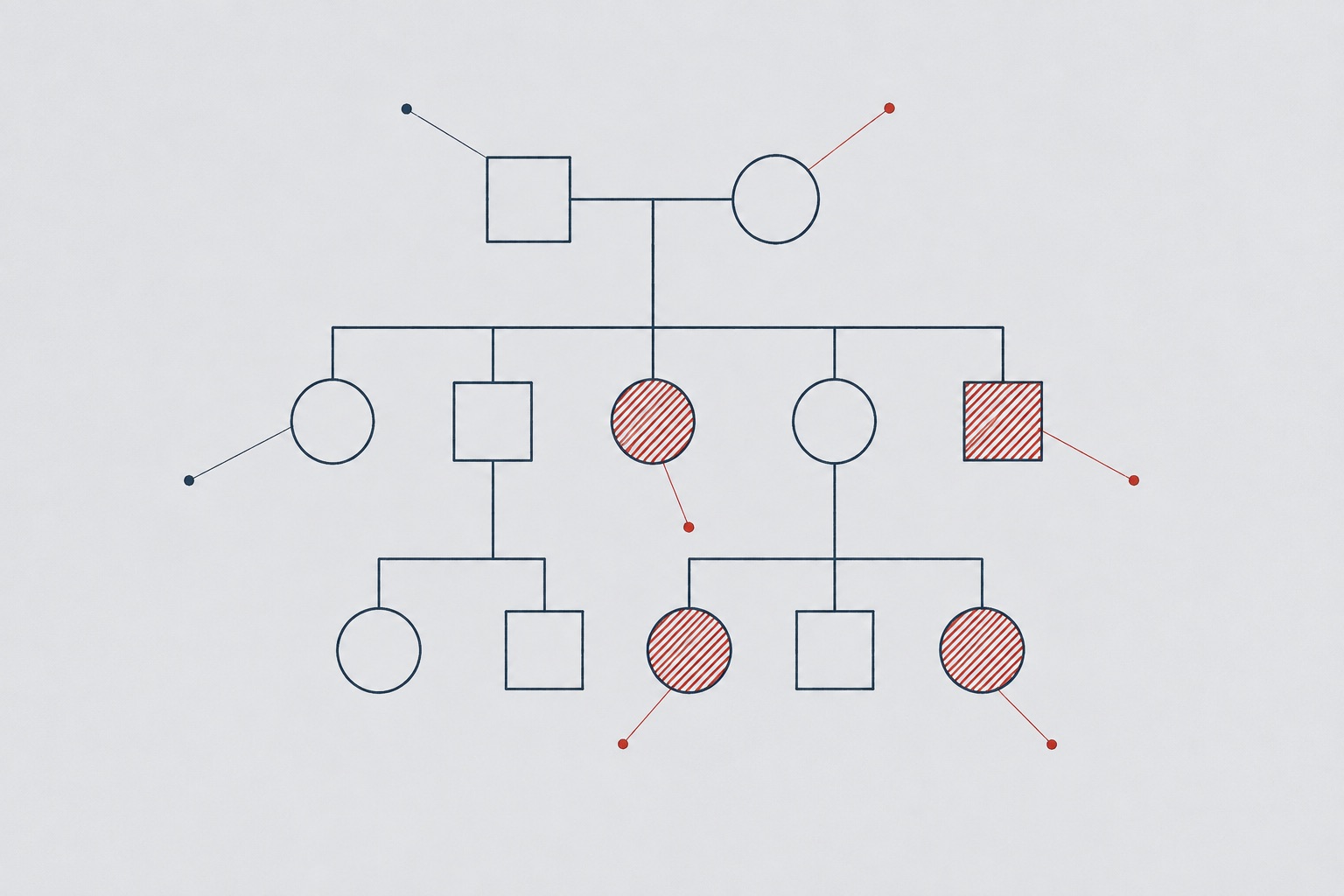
Short answer: both SCD and STD are usually autosomal recessive: each child of carrier parents has about a 25% chance of being affected. Some SCD families instead have autosomal dominant inheritance, where each child has a 50% chance. Genetic testing identifies the family's gene and turns those percentages into your family's specific numbers. GeneReviews; MedlinePlus Genetics
Recessive, in plain words.
Genes come in pairs, one copy from each parent. In recessive conditions, a child is affected only when both copies carry a change. Parents who each carry one changed copy are healthy, and typically have no family history, because carriers show nothing. For such a couple, every pregnancy rolls the same dice: one-in-four affected, one-in-four unaffected and non-carrier, one-in-two unaffected carrier.
Dominant, the other pattern.
In dominant inheritance one changed copy is enough. A parent with dominant SCD has a one-in-two chance with each child. Dominant forms sometimes look milder across generations, and occasionally appear for the first time in a child whose parents are unaffected (a new variant), which changes recurrence math for siblings of that child.
The genes involved.
Most known genes sit in the Notch signaling pathway, the chemical conversation that tells the early embryo where vertebrae and ribs should form: DLL3 (the classic STD gene, and also a cause of SCD), MESP2, HES7, LFNG, RIPPLY2, and others. Testing today usually means a panel sequencing many genes at once, or exome sequencing when the picture is unclear. Results arrive in weeks to a few months.
What testing gives your family.
- A specific name beyond "Jarcho-Levin," which sharpens prognosis conversations.
- Recurrence numbers for future pregnancies, based on your actual pattern.
- Carrier testing for siblings and relatives, if they want it as adults.
- In some families, access to research registries and future trials.
Prenatal and preimplantation options.
Once the family's gene change is known, future pregnancies can test for it: chorionic villus sampling around weeks 10 to 13, amniocentesis around 15 to 20, or preimplantation genetic testing with IVF, which tests embryos before implantation. These are options, not obligations; counselors frame each with its accuracy, timelines, and burdens, and families choose according to their own values.
The Puerto Rican founder effect.
STD has a documented founder effect in Puerto Rico: many affected families share ancestral changed copies of DLL3 carried through generations. For Puerto Rican families, a targeted test may find the family variant quickly. This history also explains why support organizations for this condition grew from the Puerto Rican community, including the foundation that ran this domain for 13 years.
Did we cause this?
No. These gene changes are present from conception, carried silently by healthy parents, usually for generations before anyone knew. Nothing in pregnancy diet, activity, or environment causes SCD or STD. Genetics counselors answer this question daily, because nearly every parent asks it, usually in silence.
A note on cousins and marriage. Recessive conditions are more common where parents share ancestry, simply because shared ancestors can share changed gene copies. This is population genetics, not blame; counselors address it factually and kindly when families ask. GeneReviews; WHO genetics education