Independent · cited · trilingual
One old name, two different conditions.
"Jarcho-Levin syndrome" entered medicine in 1938 and slowly became an umbrella for anything involving misshapen vertebrae and ribs. That breadth stopped being useful. Here is what the name meant, why it is being retired, and what to ask your doctor instead.
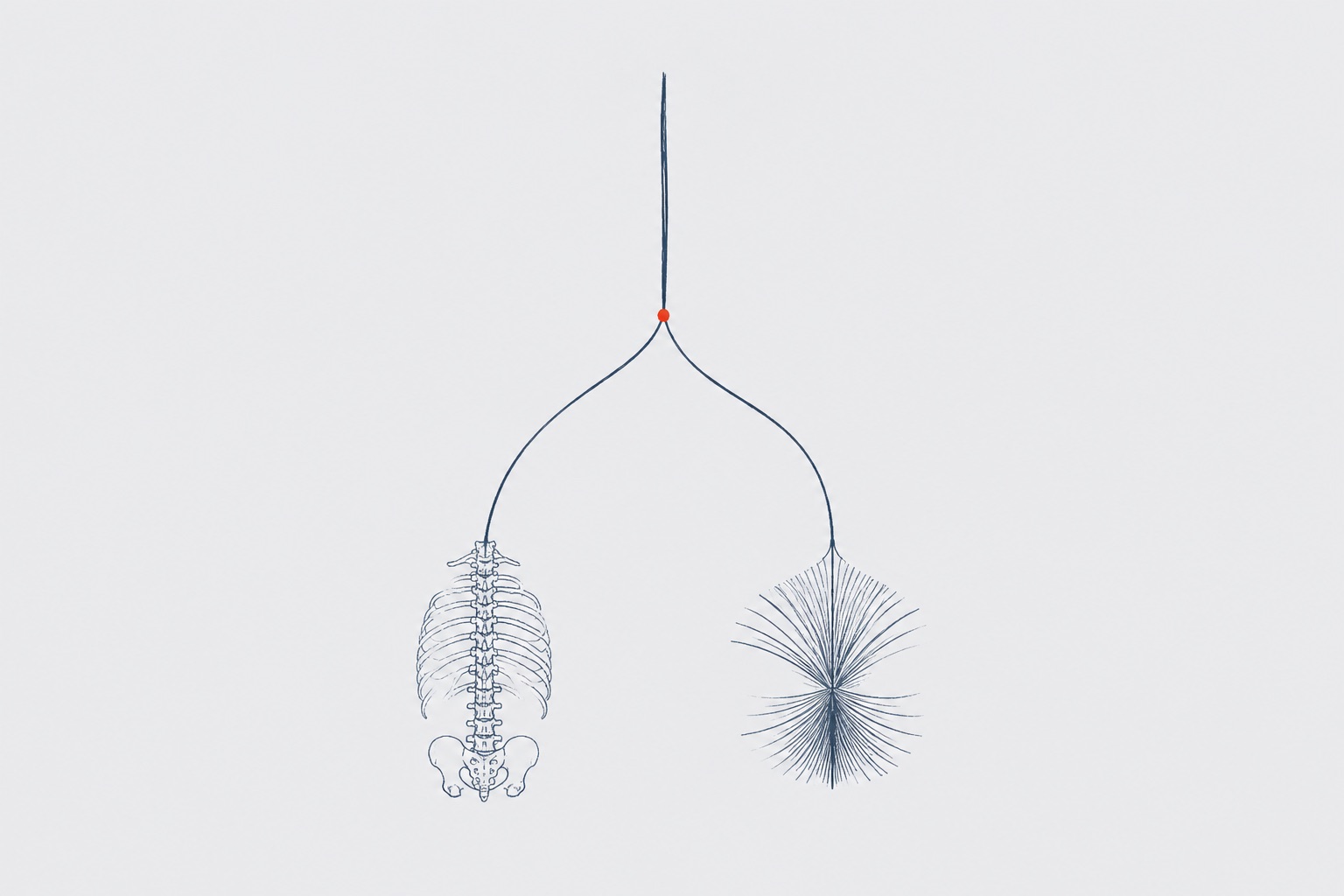
Short answer: "Jarcho-Levin syndrome" is an older umbrella name, given in 1938, for conditions now understood as two distinct diagnoses: spondylothoracic dysostosis (STD) and spondylocostal dysostosis (SCD). Medicine still mentions the old name, but genetic and clinical reviews over the past two decades recommend using the two specific names instead, because prognosis and counseling differ between them. Cornier et al., Am J Med Genet; GeneReviews via MEDLINE
Where the name came from.
In 1938, the physicians Jarcho and Levin described siblings whose spines and ribs had formed incorrectly before birth. Their report was groundbreaking, and for decades afterward "Jarcho-Levin syndrome" was used for a whole family of vertebral and rib malformation disorders. That breadth became a problem: the label covered conditions with different genes, different chest mechanics, and very different outcomes. Keeping one name for all of them meant families could not get a clear picture of what to expect.
The split that replaced it.
Today the old label points to two main diagnoses. In spondylothoracic dysostosis (STD), ribs fuse where they meet the spine on both sides, producing the small "crab-like" chest visible on X-ray; breathing support in infancy is common, and it is seen most often in families of Puerto Rican descent. In spondylocostal dysostosis (SCD), the vertebrae themselves are misshapen and often fused, and while the chest may look dramatic on imaging, the course is usually milder, with many people living into adulthood.
| The old label covered | STD | SCD |
|---|---|---|
| Main problem | Small stiff chest, breathing | Spine curvature, torso asymmetry |
| Typical intellect | Normal | Normal |
| Common genes | DLL3 and related (Notch pathway) | Several (MESP2, HES7, LFNG and others) |
| Ancestry cluster | Puerto Rican founder effect | No single group |
| Next-child chance | About 1 in 4 | About 1 in 4 if recessive; up to 1 in 2 in dominant forms |
One more confusion to clear. "Jarcho-Levin" is sometimes mixed up with Kleine-Levin syndrome, an unrelated sleep disorder with a similar-sounding name. If you arrived here searching for recurrent hypersomnia, the resource you want is about Kleine-Levin, not this site. NORD; MedlinePlus
Why this matters for your family.
Knowing which condition your child has changes the conversation: what monitoring the newborn needs, whether chest wall surgery might be discussed later, what recurrence risk a future pregnancy carries, and which patient community will speak your experience. Everything else on this site follows this fork, so start on the page that matches your situation.